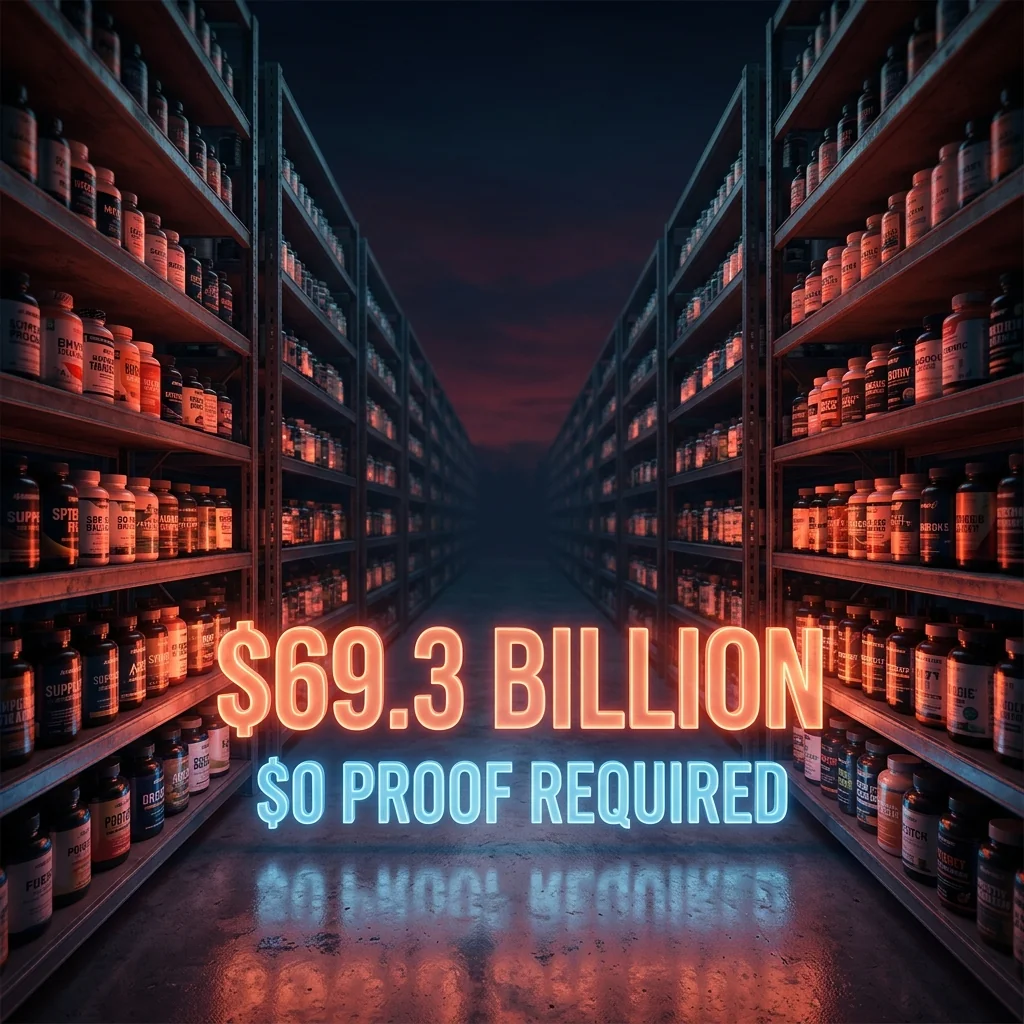
Here's a number that should make you angry: $69.3 billion. That's how much Americans spent on supplements in 2024 alone. And here's the number that should make you furious: $0. That's how much the FDA requires supplement companies to spend proving their products work before putting them on shelves.
The Supplement Industry Doesn't Need You to Know What Works.
Under a law passed in 1994, supplement companies can sell you a product without ever proving it works. They decide for themselves whether it's safe. The FDA can only step in after someone gets hurt.
That's not a flaw in the system.
That is the system.
And it's the base of a $69.3 billion industry built, on purpose, on the fact that you can't verify a single claim on that label.
I know, because I had 12 bottles of that industry's business model sitting on my desk.
The Three Tools the Industry Gave You to Figure Out If Your Supplements Are Working
Tool #1: The Influencer Recommendation.
The fitness creator you follow. The biohacking podcast you listen to. The "top 10 nootropics for focus" article you found after 20 minutes of Googling.
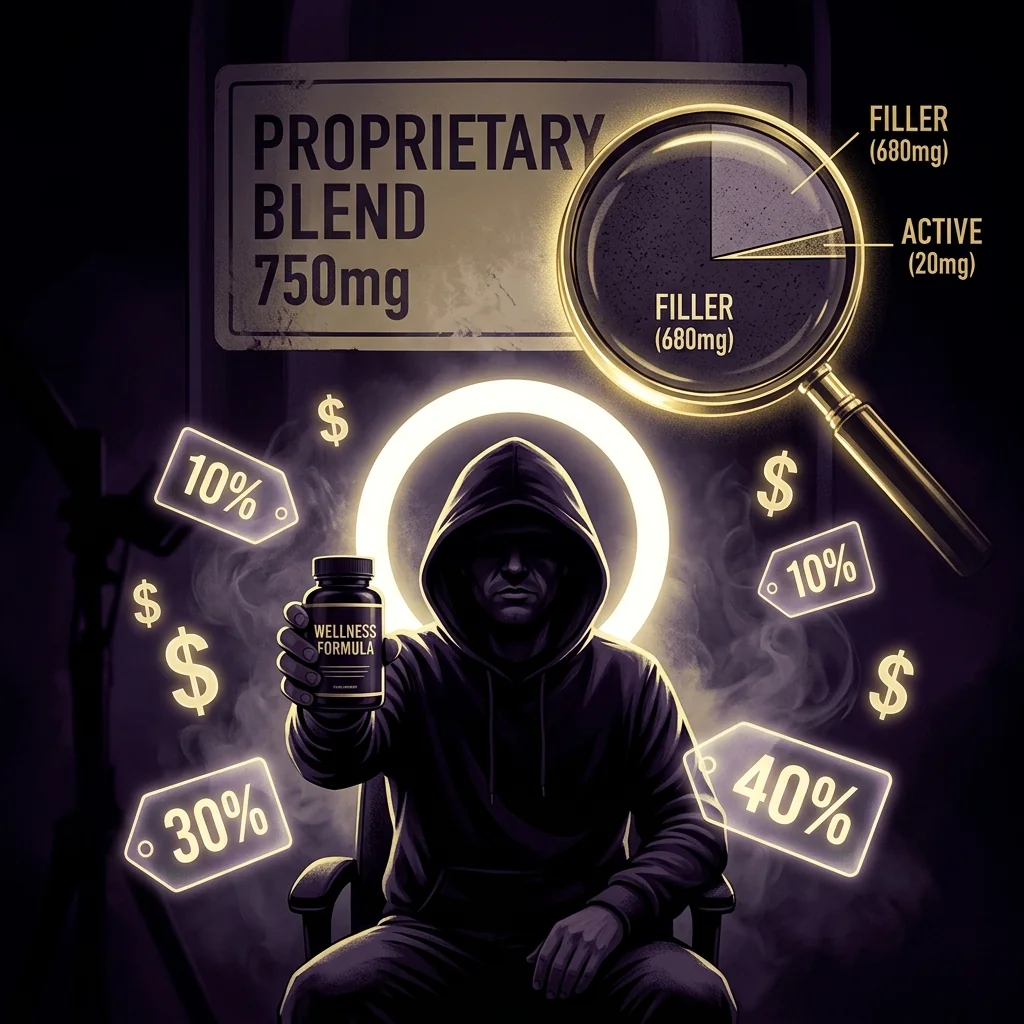
What you don't see is the cut they get on every sale. Most supplement affiliate programs pay 10–30% commission per sale, with some going as high as 40%. The FTC technically requires them to say so, but that disclosure is buried in tiny footnotes or skipped altogether.
This isn't illegal. It's just the structure. When someone's income depends on you buying a product, they lose the ability to tell you it might not work.
Tool #2: The Secret Blend.
You've seen these on labels. "Cognitive Performance Matrix, 750mg." Then a list of 8 ingredients underneath.
What they don't tell you: companies don't have to say how much of each ingredient is actually in the blend. Just the total weight. So that 750mg blend could be 680mg of cheap filler, 50mg of the ingredient they're advertising, and 20mg of everything else.
The industry has a name for this: "fairy dusting." Put just enough of a proven ingredient on the label to list it. Then advertise the study that used ten times the dose you're actually getting. Take the money.
Tool #3: Your Own Research.
You're smart. You read the studies. You dug through PubMed, scrolled Reddit threads, spent three hours comparing labels.
Three Google searches about ashwagandha safety. Three different answers. Every source had an agenda. Every "independent" review had a commission code.
And even if you got it right — even if you found the right dose of the right thing from a trustworthy brand — you still had no way to know if it was working for you.
Here's what nobody told you about tracking your own results:
Your test scores will go up over time whether your supplements are working or not.
This is called the practice effect. The more you do a test, the better you get at that test, even if nothing else changes. Mix in bad sleep, a stressful week, a new diet, and the "improvement" you think you're seeing is mostly just noise.
The tools the industry gave you are broken.
Not by accident. By design.
Because a customer who can actually measure results is a customer who can stop buying things that don't work.
I Was That Customer.

I'm an AI engineer. Twelve hours a day, writing code. I build data systems for a living, and the difference between doing my best work and just getting through the day is almost entirely about how sharp I feel at 9 a.m.
So I had a stack. Of course I had a stack. Twelve bottles lined up on the corner of my desk like I'd figured something out. $150 a month. A spreadsheet I called "data." I'd sit there at midnight, hunched over my monitor, squinting at columns I'd built to track my own brain, convinced that one more data point would finally make it all clear.
It never did.
The week I started my new stack, I'd also started sleeping an extra 30 minutes. The week I felt the sharpest, I'd had a light workload. The week I felt foggy, I'd just gotten off a cross-country flight. Every pattern I thought I was seeing had another explanation I hadn't accounted for.
I wasn't dumb. I write code that catches exactly this kind of mistake every day.
I was using broken tools and calling the results science.
The day I admitted that was the day I started building something different.
The Approach That Actually Works
I used the same approach I use to debug software, and I applied it to my supplement routine.
Brain tests that actually work — the kind used in clinical research, where the difficulty adjusts as you improve. So every time you test, you're measuring how sharp you are, not just how familiar the test feels.
Automatic tracking of outside factors, logging your sleep, stress, workload, and diet alongside your stack. So the system can tell the difference between "this supplement is working" and "you slept an extra hour."
An AI engine that connects what you take to how you actually score over time. Not generic advice. Not a chatbot pulling from old studies. A system that figures out what works for your body.
The First Real Finding Came Three Weeks In.

My L-theanine to caffeine ratio was off. I was taking them 1:1, but my scores were consistently better at a 2:1 ratio. A small change — the kind no "top 10" list would ever catch because it's specific to me.
My creatine timing was off by four hours. Four hours.
Two other things I was taking showed no effect at all. Six weeks of data. Zero change in any score I was tracking. I'd been paying for them every month and calling it optimization.
I cut those two. Got $45 a month back. Kept every bit of improvement I'd seen.
Short term: I started writing cleaner code. I worked faster. I could feel the difference between a sharp morning and a slow one — and more importantly, I could see it in my scores. No more guessing. No more hoping something was working. The data told me what to keep and what to drop.
Long term: I stopped paying for things that didn't work for me and focused on what the data said actually did. Not what an influencer said. Not what a label implied. What my numbers said, matched against my life.
That's what real tracking looks like.
That's what 2,000+ people are now doing on Nootropic.ai — the platform I built because the supplement industry wouldn't.
Here's what it gives you for free:
- Daily brain tests: adjusted for the practice effect, takes 60 seconds. Your score is a real number, not a feeling.
- One-tap stack logging: 15 seconds. Log what you took, when, and how much. Start building actual data.
- 500+ supplement database: evidence ratings, effective doses, interaction warnings, real user results. No affiliate links. No paid placements. No commission codes.
- Free tools: Caffeine + L-Theanine ratio calculator. Interaction checker. Half-life calculator. Cycling schedule. Stack builder. Cognitive baseline test.
- 30+ research-based articles: written like a knowledgeable friend who saves you from the $1,800 mistake. No vague "it may help" language.
Once you've built three weeks of data, the AI engine shows you what's actually moving your scores.
What to keep. What to cut. What was never doing anything.
The average user cuts three supplements and keeps all of their results.
That's $65 a month back in your pocket. Every month. For good.
Your Three-Step Mission. Fifteen Minutes Total.
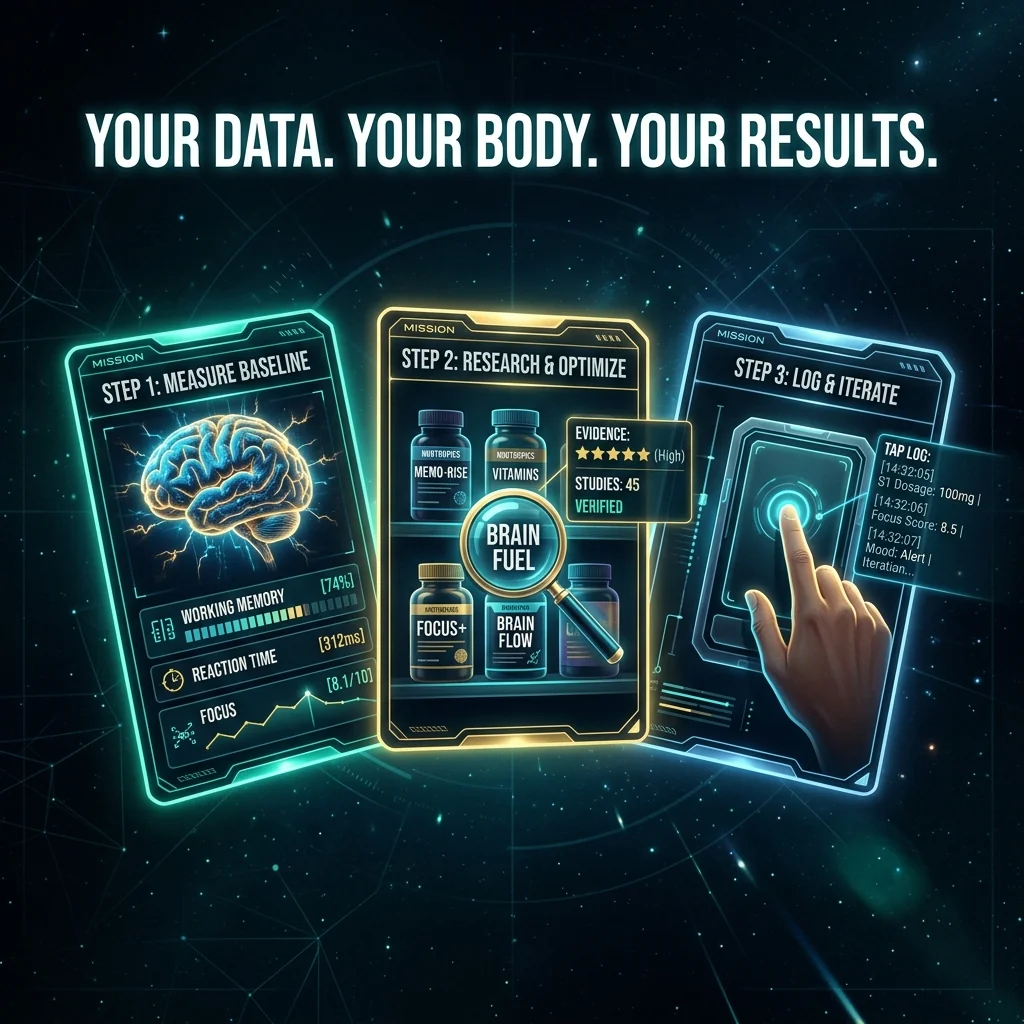
Step 1: Get your baseline. (2 minutes)
Go to nootropic.ai and take the Cognitive Baseline Test. No account needed to start. You'll get your working memory, reaction time, and focus scores — real numbers, not a quiz telling you "you might benefit from Lion's Mane."
This is your starting point. You can't track progress without it.
Step 2: Check your shelf. (10 minutes)
Open the supplement database. Look up everything you're currently taking. Check the evidence rating. Check the effective dose. Then check what's actually in your product.
You might find what I found: half your stack is filler. The other half might be the right ingredient at the wrong dose, or the right dose at the wrong time.
It takes ten minutes. It might save you hundreds of dollars a year.
Step 3: Log your stack today. (15 seconds)
One tap. What you took, when, and how much. Day one of your data.
You won't have answers in a week. But in three weeks, you'll have something no "top 10" list, no podcast, and no supplement label has ever given you:
Your data. Your body. Your results.
Start free at nootropic.ai
No credit card. No referral code. No commission in this link.
Just the tools the industry refused to build, made by one engineer who got tired of guessing.
Blaise Pascual
Founder, Nootropic.ai
AI Engineer | I build tools to replace supplement guesswork with data
P.S. The AI engine that connects your stack to your scores is free right now during early access. People who set their baseline today will get first access to Pro features at the founding price when we launch. Three weeks of your data is worth more than any discount code.