
It's 11pm on Mother's Day weekend. My 1-year-old is finally asleep. My wife, the reason any of this is possible, is resting after a day where I made sure she felt celebrated. The house is quiet for the first time in 16 hours. And I'm staring at a terminal, deploying an AI video ad studio I built from scratch in 48 hours.
The Builder's Bottleneck
Every founder I talk to has the same problem.
It's not ideas. They have too many of those. It's not capital. Most SaaS products can be bootstrapped for $0 in 2026. The real killer is throughput.
The distance between "I should build this" and "it's live, people are using it" is where 90% of founders go to die. They stall in research. They get stuck in design committees of one. They wait for conditions to be perfect before writing the first line of code. And every week that passes without shipping, a competitor closes the gap.
Here's the contrast that keeps me up at night:
What is: Most founders spend more time talking about building than actually building. They have 47 browser tabs open, a Notion board full of "ideas to explore," and a Figma file they haven't touched in three weeks. They're preparing to prepare.
What could be: A founder who ships a working product every single week. Someone whose ideas don't sit in a notebook. They sit in production, collecting users and feedback, compounding in real time.
I know both versions of that founder. Because I've been both.
After leaving the Marine Corps in 2023, I co-founded a startup and got burned by a technical co-founder who couldn't ship. I lost a six-figure contract because I couldn't audit the code myself. I remember sitting in my car after that call ended, staring at my phone, realizing I'd handed my future to someone who didn't treat it like their own.
I swore I'd never be a technical hostage again.
So I learned to build. Not just code. The entire operational stack: frontend, backend, AI pipelines, deployment, design. Every layer. I taught myself the way Marines learn anything: by doing it badly, then doing it again, then doing it until the bad version is unrecognizable from where I started.
And now the bottleneck has flipped. I can build faster than I can distribute. Which is its own problem. And one I'm solving in public.
Here's what that looks like in practice.
Restless: A Tactical E-Commerce Redesign
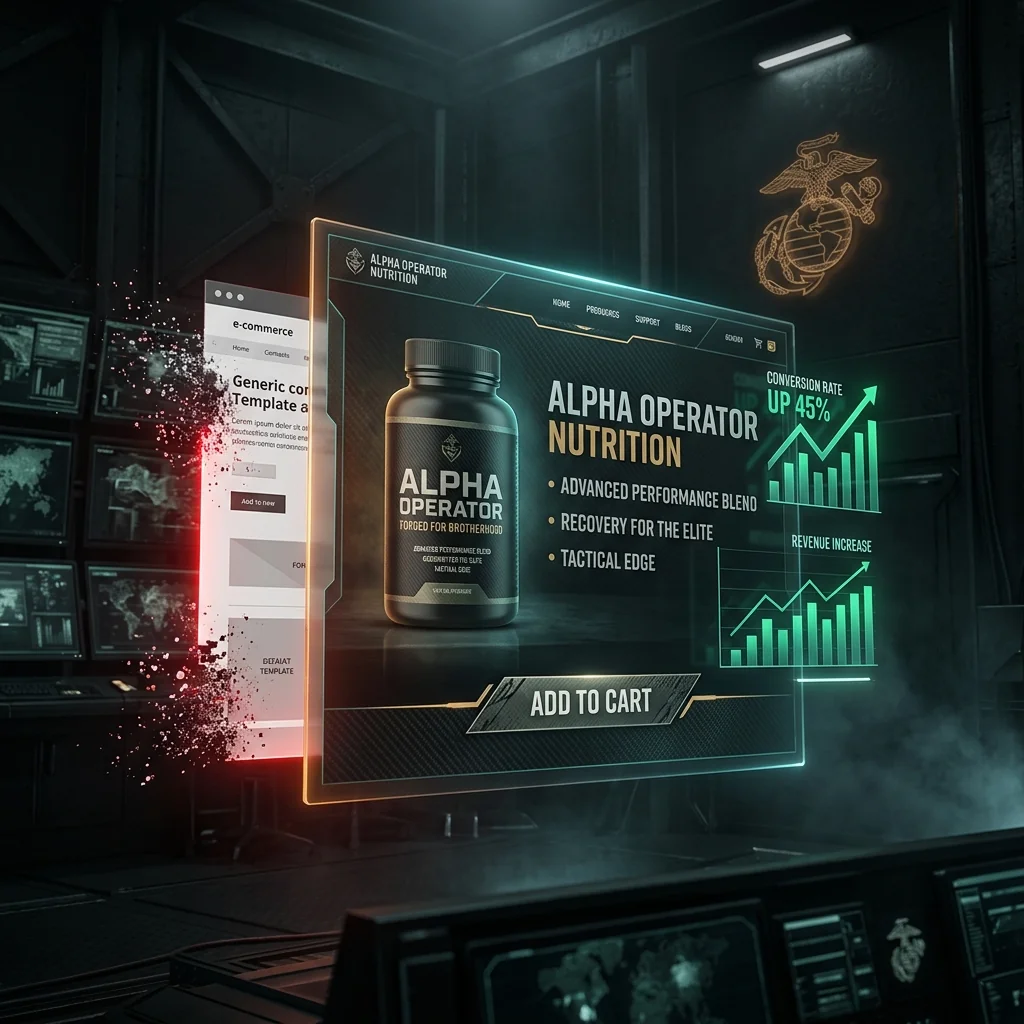
My TBS platoon-mate Daniel runs Restless, a performance energy blend company built for operators and veterans. We served together as Marine officers. Now we're both veterans building businesses on the other side.
His product is the real deal: clean caffeine from green tea, L-Theanine at a 2:1 ratio, 1,000mg electrolytes, 23 vitamins. Informed Sport Certified. But the old website? It wasn't telling that story. It was hiding it behind a generic template that made a premium product look like every other powder on Amazon.
So I rebuilt the entire landing page. Not a template swap. A full tactical redesign. Dark, high-contrast UI. A hero section that communicates "mission fuel" in under 3 seconds. Ingredient deep-dives with real clinical context. Social proof blocks. Mobile-first. Conversion-optimized from the first scroll.
Why I did this for free: Because Daniel is a fellow veteran who bet on himself after the military. That's a bet I'll back every time. Veterans helping veterans build real businesses isn't charity. It's the network effect of shared discipline. And honestly? I got to sharpen my e-commerce design chops on a real product with real customers. That's worth more than a check.
The takeaway for you: Your portfolio is built in public. Every project you ship, paid or not, is a proof of concept that your next client evaluates before they ever get on a call with you. I didn't "do a favor." I built a case study.
Nootropic.ai: The Gamification Suite

Here's a number that used to keep me up at night: $150 per month. $1,800 per year. That's what I was spending on cognitive supplements I couldn't prove were working.
12 bottles on the shelf. Zero objective data. I'd "done the research," but if you'd asked me which compound was actually improving my cognition, I would have just stared at you.
So I built the instruments myself. Nootropic.ai is a platform with practice-effect-controlled cognitive tests, automated confound adjustment, and an AI correlation engine that tells you what's actually moving the needle. It's live. It's growing. People are using it.
But here's the problem I kept running into: people would sign up, log for three days, forget for a week, and their data would become useless. The science was solid. The habit wasn't sticking.
This week, I shipped the fix. A full gamification layer:
- Streaks. Log your stack daily, build momentum, don't break the chain.
- Daily Goals. Micro-targets for logging, testing, and learning about your compounds.
- Leaderboards. See how your cognitive scores compare to the community.
The game mechanic serves the science. Streaks and leaderboards turn "I should log" into "I need to log." That small shift in motivation is the difference between noisy data and a dataset that actually tells you which supplements to keep and which to drop.
The deeper strategy: Every feature I ship on nootropic.ai feeds the flywheel. More daily active users means more data. More data means better AI correlation insights. Better insights means more value for Pro subscribers. More value means more revenue. More revenue means more features. Gamification isn't a nice-to-have. It's the engagement engine that makes the entire product work.
Mirror App: Daily Devotions (Work in Progress)
I started building a Daily Devotion engine for the Mirror App. The idea: personalized spiritual formation content generated for each user's specific journey. This one isn't shipped yet. It's still very much a work in progress.
But here's why I'm sharing it anyway.
The same AI engineering that powers nootropic.ai's correlation engine — taking personal data and turning it into personalized insights — applies directly to spiritual formation. Your prayer life, your struggles, your growth areas. All of it can be surfaced and supported by technology that meets you where you are.
The pattern is the same thesis, applied to a different domain. Identify a problem where personalization matters, where generic advice fails, and where people are underserved by existing tools. Build the instrument. Let the data serve the person.
Faith and technology aren't in tension. They're meant to work together. More on this soon.
StoryFarm: AI Video Ad Studio
Saturday morning. Mother's Day weekend.
My wife looked at me and said: "Go build."
So I did.
I had two targets for the weekend: submit a game for the Wilmington IO game jam, and build an AI video ad studio for the Runway API hackathon. The game jam didn't make it. Sometimes 48 hours isn't enough when you're splitting focus, and I'd rather ship one thing properly than two things poorly. But StoryFarm? StoryFarm shipped.
This is the project I'm most excited to talk about, because it solves the problem I hit every single week:
I can build apps faster than I can market them.
Distribution is the hardest problem in entrepreneurship. Always has been. I can ship a SaaS product in a weekend, but getting it in front of the right people? That takes content. Lots of it. Video content especially: UGC-style ads, product demos, social clips. The stuff that actually converts on Instagram, TikTok, and YouTube.
Here's the contrast:
What is: You're a solo founder. You just shipped something great. You know video converts, but you can't afford a production team. So your product sits there, invisible, while someone with a bigger marketing budget sells an inferior version of the same idea.
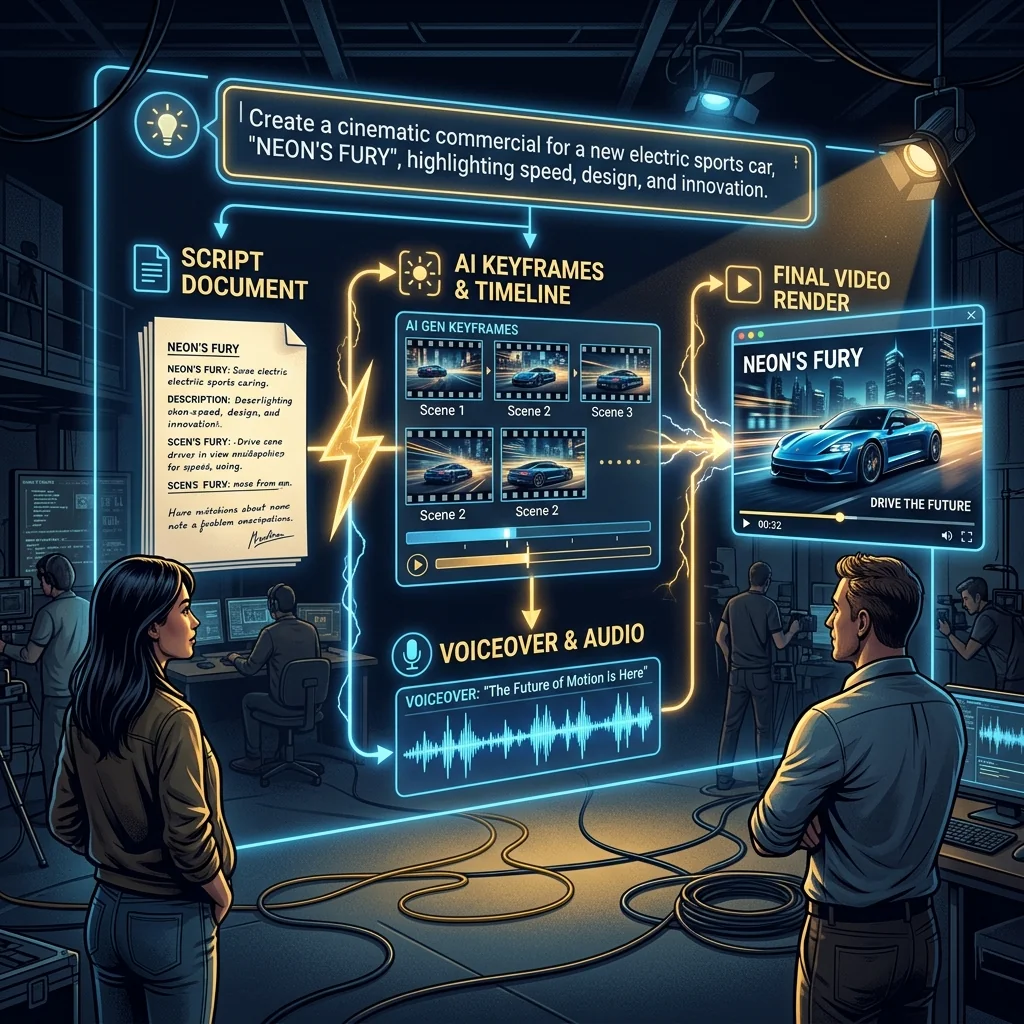
What could be: You type a concept into a tool. Ten minutes later, you have a fully rendered video ad with a script, voiceover, keyframes, and cinematic motion. You're the director. The AI is your production crew.
That's StoryFarm.
Here's how it works:
- Describe your ad. The vibe, the product, the hook.
- AI writes the script. A Strategist agent crafts the narrative, segments it into micro-clips, and maps emotional beats.
- Generate keyframes and voice. Gemini creates photorealistic first-frames. ElevenLabs synthesizes the voiceover.
- Render to video. Runway Gen-4.5 Turbo renders each keyframe into cinematic motion.
StoryFarm is the first tool in what will eventually become VidFarm.app: a full suite of AI-powered distribution tools designed to feed entrepreneurial throughput.
My honest take on AI content: Is AI-generated video perfect? No. Is it authentic in the way a founder talking to camera is? Not yet. But as a solo founder, I need leverage. AI video in 2026 has crossed the threshold where it effectively communicates the value of a product if you nail the harness. The script-first architecture matters. The emotional beat mapping matters. The character anchoring matters. Garbage in, garbage out. But if you treat the AI like a production crew and yourself as the creative director, the output is good enough to drive real distribution.
I'm building the tools that close the gap between "I shipped a product" and "people actually know it exists."
The Solo Founder's Weekly Sprint
You don't need my build speed. You need my system. Here's the operational framework:
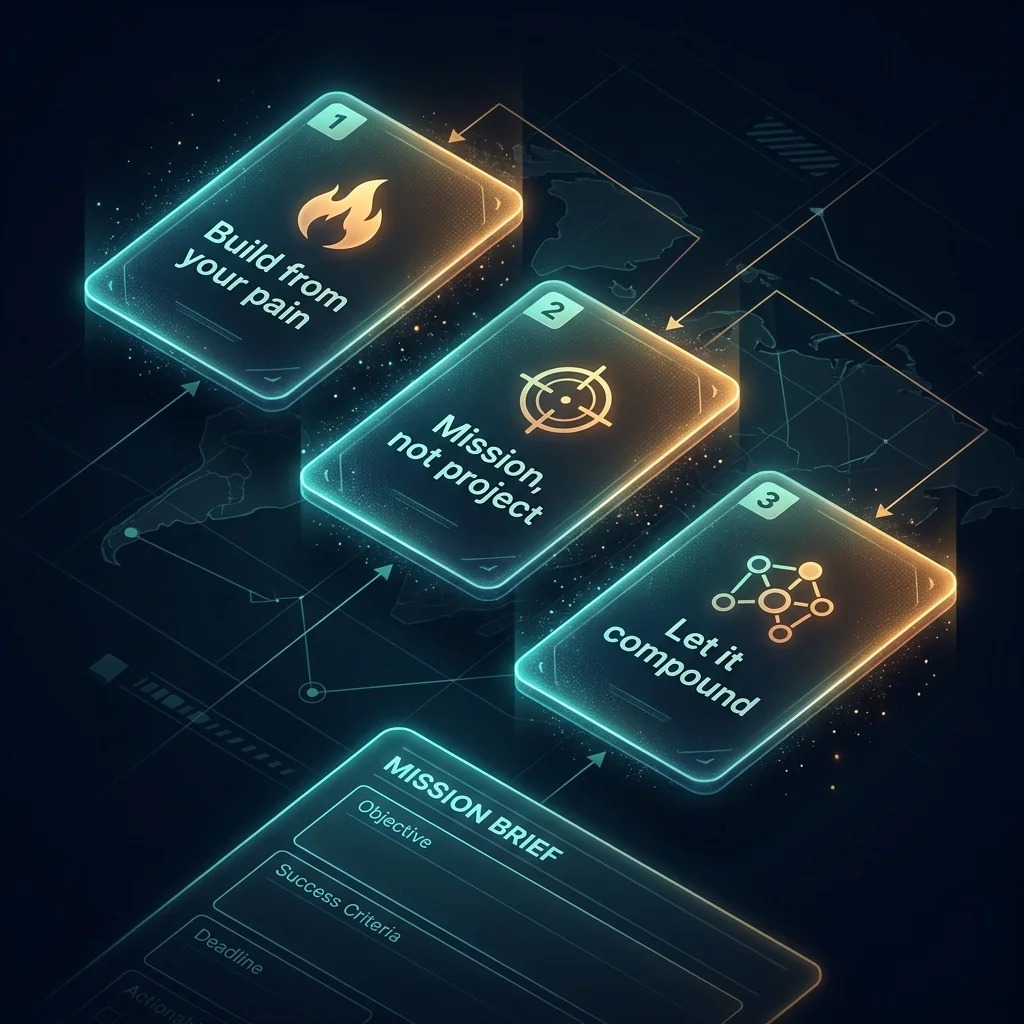
The 3 Rules of Hyperfast Shipping
Rule 1: Build from your own pain. Every product I shipped this week solves a problem I personally have. Nootropic.ai exists because I had 12 bottles and no data. StoryFarm exists because I can build faster than I can market. Mirror's Devotion feature exists because I want deeper spiritual formation. When you build from genuine need, you skip months of "market research." You ARE the market.
Rule 2: Treat every build as a mission, not a project. A project has a start date and a vague scope. A mission has an objective, success criteria, and a deadline. When I sat down Saturday morning to build StoryFarm, the mission was clear: "Ship a working AI video ad studio by Sunday night. Success criteria: generate a complete video ad from a text prompt. Deadline: 48 hours." That clarity eliminates decision fatigue. You stop asking "what should I work on?" and start asking "is this done yet?"
Rule 3: Let the portfolio compound. Every app I build feeds the others. Nootropic.ai teaches me about consumer SaaS engagement, and I apply those lessons to Mirror. StoryFarm generates marketing content for nootropic.ai, which drives users, which generates data, which improves the product. Restless gives me an e-commerce case study, which attracts B2B clients for Paladin Front. Nothing is isolated. Everything compounds.
Your Action Step This Week
Pick the ONE idea you've been sitting on. Not the best one. The smallest one. Give yourself 48 hours. Write the mission brief:
Objective: [What you'll ship] Success criteria: [How you'll know it's done] Deadline: [This weekend]
Then build it. Ship it. Show people.
That's one OODA loop. That's one proof of concept. That's one case study your future clients and customers will evaluate.
Stop planning. Start shipping.
The Bottom Line
4 projects shipped. A hackathon completed. A game jam attempted. Homework finished. Family first.
A veteran-owned supplement company redesigned. A cognitive optimization platform made stickier. A spiritual formation tool started. And a distribution problem turned into a distribution product. All while walking to the park with my family on Mother's Day weekend.
This is what the Autonomous Founder looks like in practice. Not a theory. Not a framework diagram. Working products, real momentum, compounding returns. And a wife who makes it all possible by believing in the mission even when the hours get ridiculous.
If you're building something and need it shipped at this speed — whether it's a web app, a mobile platform, or an AI integration — that's exactly what Paladin Front does. One founder. Agent squad. Your product shipped in weeks, not quarters.
If you want to stop guessing about your supplement stack and start knowing what actually works, nootropic.ai is free to start.
And if you need video content but can't afford a production team, StoryFarm is live. Type a concept. Get a video ad.
Mission accomplishment isn't a suggestion. It's the standard.
Grateful for the grind. More grateful for the people who make it worth grinding for.
Blaise Pascual
Founder, Paladin Front | Nootropic.ai | StoryFarm
Marine Veteran | AI Engineer | Autonomous Founder
P.S. StoryFarm is live right now. If you've been sitting on a product that needs video content, go type your concept into storyfarm.blaisep.com and see what comes out. Ten minutes from prompt to rendered video ad. The distribution bottleneck is officially optional.