
42% of SaaS startups die for one reason: they build something nobody wants.
They spend $50k and six months engineering a feature nobody asked for, then hold an all-hands meeting to ask why the market ignored them. I know because I almost became that statistic.
In the United States Marine Corps, a slow decision cycle means missed deadlines, blown operations, and leaders who lose the trust of everyone above and below them. In SaaS, it just drains your bank account — quietly, until you check your runway one morning and realize you have sixty days of oxygen left. The difference between the founders who survive and the ones who don't isn't talent, funding, or luck. It is how fast they cycle through a decision loop.
Colonel John Boyd — the fighter pilot and military strategist who shaped modern air warfare — called it the OODA Loop: Observe, Orient, Decide, Act. I first learned about Boyd in flight school, and his core thesis has never left me: the combatant who resets their decision cycle faster than their opponent will win, regardless of size or resources. Not the one with more firepower. Not the one with better intelligence. The one who adapts faster.
Here is how I apply this battle-tested framework to pivot code in 4 hours, not 4 weeks — and why it turns one disciplined founder into a force that outperforms teams of fifty.
The Technical Hostage Trap
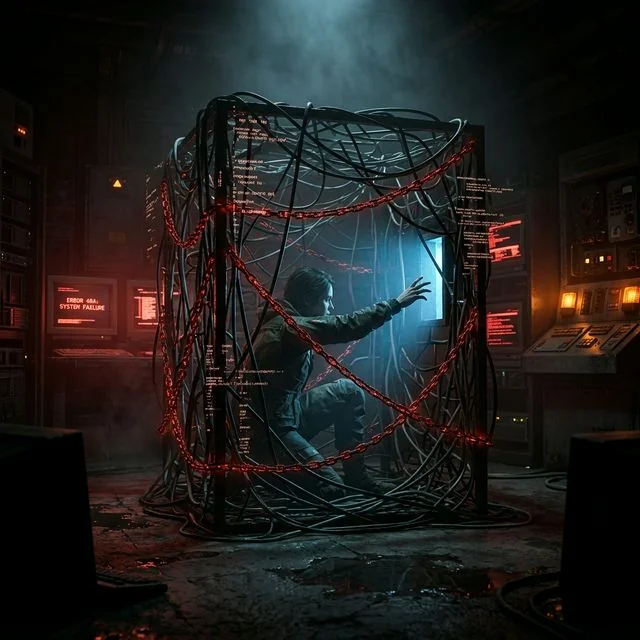
The biggest threat to a non-technical founder isn't a competitor. It isn't even a recession. It is their own lack of operational speed.
I learned this the hard way. After leaving active duty in 2023, I co-founded a startup. I had the vision, the market, and the contract on the table. What I didn't have was the technical ability to evaluate my partner's work — or the tactical loop to see the friction building before it was too late. By the time I realized the product wasn't being shipped, the client had moved on. That single failure — being a "technical hostage" — cost me a six-figure contract and a year of momentum.
Most founders are living a version of that same story right now. They are stuck in what I call the "Decide and Pray" loop. They decide on a product direction, pray it works, and by the time the data screams that it hasn't, they've run out of ammo — capital, energy, credibility. They lack what I needed back then: a mental governor that forces them to observe the battlefield, orient to the truth, and act before the window of opportunity slams shut.
Why This Problem is Getting Worse, Not Better
Here is the paradox of 2026: technology has never been more powerful, yet the margin for error has never been thinner.
Product-market fit is no longer a milestone — it is a moving target. Analysts are now tracking a phenomenon called "PMF Decay," where the fit you achieved last quarter erodes as markets shift under you. New AI models rewrite customer expectations overnight. A competitor can clone your feature in a weekend with two AI coding agents and a cup of coffee.
Meanwhile, the data is brutal:
- 42% of SaaS startups fail because there is no market need for their product — they built the wrong thing.
- 34% fail from a lack of product-market fit specifically — they found an audience but couldn't hold it.
- 69% of startup project failures in 2026 trace back to marketing mistakes, the majority of which are misreading or ignoring the market altogether.
Every one of those percentages represents a founder who was cycling too slowly. They observed too late, oriented to their ego instead of the data, decided based on sunk cost, and acted on hope instead of intelligence.
The OODA Loop exists to fix exactly this. It was designed for military operations where the wrong decision at the wrong time is irreversible. Your SaaS company doesn't have those stakes — which means you have even less excuse for a slow cycle.
The Agent Squad Doctrine
Speed is security. To win, you must reset your decision cycle faster than the market changes around you. Here is how the OODA Loop transforms a solo founder into a 50-person agency:
Phase 1: OBSERVE — Intelligence, Not Guessing

We don't guess. We deploy AI agents to scrape sentiment, monitor competitor feature launches, log every customer support ticket, and track every friction point in our user funnel.
As a Marine officer, I learned that the observation phase is about collecting intelligence before you brief the commander. You don't wait for problems to surface in a staff meeting — you task your people to find friction points and report back before they become crises. In SaaS, your intelligence collectors are automated systems:
- Sentiment scraping agents that monitor Reddit, X, app store reviews, and support channels every 24 hours.
- Competitor tracking — when a rival ships a feature or changes pricing, you know within the day, not the quarter.
- User behavior data — heatmaps, session recordings, churn signals. The product is telling you what's broken. Most founders aren't listening.
The goal here isn't drowning in dashboards. It is signal over noise. You must know the three things your customers complained about this week — not a 40-slide deck with color-coded pie charts.
Phase 2: ORIENT — Kill Your Ego Before It Kills Your Product
This is where 90% of founders fail. Orient means filtering raw data through your Vision, Mission-Essential Tasks, and hard truth — not through your ego.
Boyd considered "Orient" the most important phase, and he was right. Most founders skip it entirely. They observe a data point ("users aren't using Feature X") and jump straight to a decision ("let's redesign Feature X"). They never ask the harder question: Should Feature X exist at all?
Orientation demands honesty. You have to hold every assumption up to the light:
- "Is this feature aligned with our mission, or did I build it because I thought it was cool?"
- "Does the data say 'pivot,' even though my ego says 'persist'?"
- "Am I optimizing for my vision of the product, or my customer's reality?"
In combat sports — Muay Thai, BJJ — there is a principle: the tape doesn't lie. When you watch yourself fight on video, you see every mistake your adrenaline hid from you in the moment. The Orient phase is watching the tape. It is your After Action Review (AAR) applied to product decisions.
If the data says your pricing model is wrong, your ego does not get a vote.
Phase 3: DECIDE — Missions, Not Features
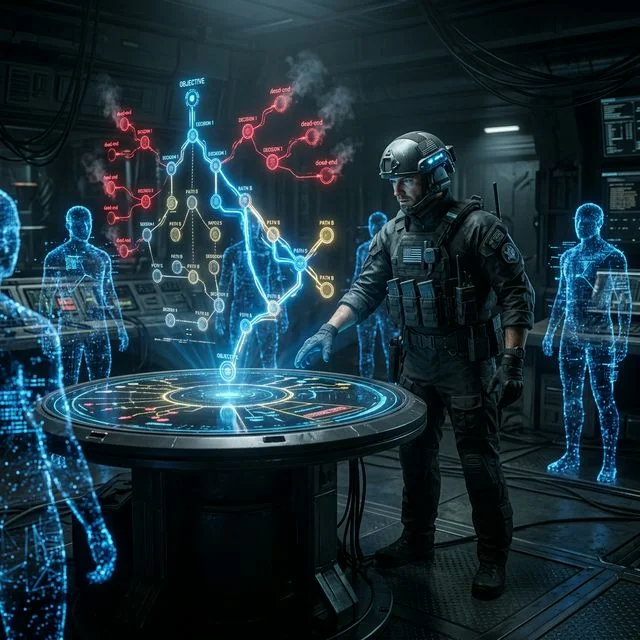
We don't decide on "features." We decide on missions.
A feature is a checkbox on a roadmap. A mission has a clear objective, success criteria, and a deadline. When I orient and see that user onboarding has a 40% drop-off at step three, I don't write a Jira ticket that says "improve onboarding." I issue a mission:
Mission: Reduce step-three drop-off by 50% within 72 hours. Success criteria: retention rate from step 3 to step 4 exceeds 80%. Agent squad resources allocated: 1 AI code agent, 1 AI UX copy agent. Commander's intent: simplify the friction, do not add steps.
That is the difference. A mission has clarity, urgency, and accountability. A feature is a suggestion.
The key insight here — and this is where the one-person unicorn concept becomes real — is that you are not deciding alone. In 2026, 36.3% of all new global startups are solo-founded. Sequoia Capital is adjusting its underwriting models to account for what they call "Agentic Leverage" — tiny teams producing outsized output through AI agent orchestration. This isn't theory. This is the new competitive reality.
Phase 4: ACT — Ship in Hours, Not Sprints

This is where the Agent Squad Doctrine takes over.
I command a squad of AI coding agents the same way I ran a staff section in the Marines: with clear Standard Operating Procedures (SOPs), defined responsibilities, and a bias toward action. When the mission is issued, the agents execute:
- One agent rewrites the onboarding UI based on the mission parameters.
- Another generates updated copy using the psychological principles from the user data.
- A third writes and runs the test suite.
- I review, approve, and deploy.
Total time from "Observe" to "shipped fix in production": 4 hours. Not four sprints. Not a two-week development cycle with three standups and a retrospective. Four hours.
When you shorten the distance between Observation and Action, you become unkillable.
SaaS companies that reduce their OODA cycle from months to days see up to a 45% improvement in competitive win rates. That's not a motivational poster — that's operational intelligence.
Your 72-Hour Tactical Pivot
Don't wait for a board meeting. Don't wait for Q3 planning. Implement this Mission-Essential Drill in the next 72 hours:
Step 1: The AAR (After Action Review) — Observe
Spend 30 minutes reviewing your last 7 days. List the top 3 friction points your customers experienced — not what you think is broken, but what they told you through support tickets, reviews, churn data, or direct messages. Write them down. Rank them by severity.
Step 2: The Orientation Audit — Orient
For each friction point, ask one brutal question: "Is this friction point caused by a feature I built for my customer, or a feature I built for my ego?" If it's the latter, mark it as dead weight. If it's the former, it's a candidate for a mission.
Step 3: Mission Brief — Decide
Pick one friction point — the one causing the most churn or the loudest complaints. Write a mission brief in this format:
Objective: [What will change] Success criteria: [How you'll know it worked] Deadline: [Tomorrow morning] Resources: [Which AI tools/agents you'll use]
Step 4: The Agent Sprint — Act
Execute the mission. Use an AI coding assistant to ship a fix, rewrite the copy, simplify the flow — whatever the mission demands. Deploy it. Then immediately cycle back to Observe: watch the data for 48 hours and see if the fix moved the needle.
That is one full OODA Loop. You just did in 72 hours what most companies take a quarter to start discussing.
The Bottom Line
John Boyd didn't care about being the biggest. He cared about being the fastest. He proved — across decades of warfare and strategy — that the entity cycling through Observe-Orient-Decide-Act faster than its opponent wins, period. Size, budget, and pedigree are irrelevant if your loop is faster.
Your SaaS company is in a competitive fight right now. Every day you spend building without observing, orienting without honesty, deciding without missions, or acting without agents — is a day your competitor is closing the gap.
Mission accomplishment isn't a suggestion. It's the standard.
If you're tired of being a technical hostage and want to build a system that actually ships at the speed the market demands — let's talk.
→ Learn how we ship at PaladinFront.com