
It was a Tuesday morning at UNCW. I was hunched forward in a lecture hall seat, laptop open, watching my professor walk through slides about a concept I'd shipped to a paying client the week before.
Not a theoretical exercise. A deployed system. In production. For money.
I looked around the room. Fifty students copying notes on something I'd already built. My professor was teaching last semester's theory. I was fielding Slack messages from a client whose AI agent I'd architected that morning.
The dissonance wasn't subtle — it was physical. My chest was tight. My leg was bouncing. Every minute in that seat felt like a minute I was falling behind.
I had a 4.0 GPA.
And I asked myself the only question that matters in the OODA Loop: Given what I now observe, what's my next move?
I dropped out.
The Canyon Nobody Wants to Talk About

Here's the uncomfortable truth I was staring at:
The cycle time for a college curriculum is twelve times slower than the cycle time for the technology it claims to teach. Syllabi revise every 3–5 years. AI tools turn over every 3–5 months.
That's not a gap. It's a canyon.
And the data confirms what I felt in that lecture hall:
- 68% of AI roles remain unfilled — not because there aren't enough graduates, but because graduates lack production skills (Industry AI Skills Report)
- 55% of recent grads say their programs didn't prepare them for generative AI in the workplace (Cengage Group, 2025)
- 65% of students say they already know more about AI than their professors (Cengage Group, 2025)
That last number isn't arrogance. It's a measurement of how fast the ground is moving under higher education's feet.
And it tracks with what I lived: I was sitting in a lecture hall learning slower than I was building.
The Meta Moves Every Twelve Months. Syllabi Don't.
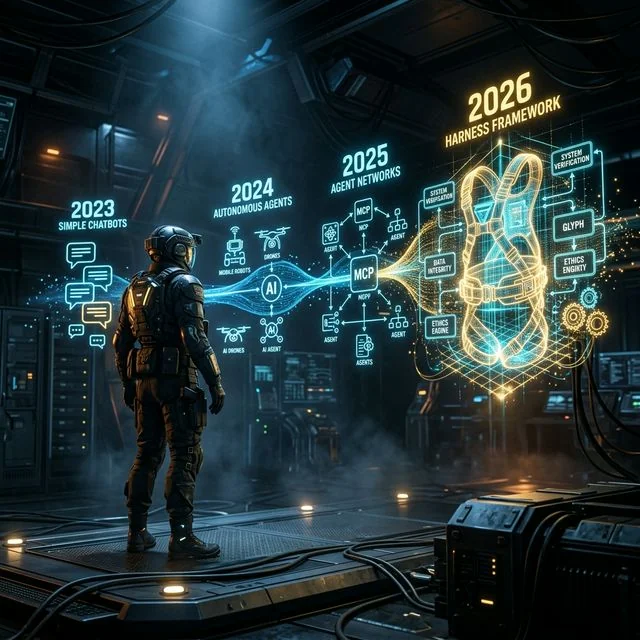
If you've been paying attention to AI — really paying attention, not just using ChatGPT to write emails — you've watched the skills meta shift four times in three years:
| Year | The Meta |
|---|---|
| 2023 | AI Chatbots — everyone discovers prompting |
| 2024 | AI Agents — autonomous task execution |
| 2025 | AI Agents + MCPs — connecting agents to real-world tools and data |
| 2026 | Harness Engineering — building the infrastructure that makes agents reliable and safe |
Each wave made the last one table stakes. Each one moved faster than any university could respond.
Harness Engineering is the discipline of building architectural constraints, feedback loops, verification guardrails, and lifecycle scaffolding around AI agents. McKinsey and ThoughtWorks now say the harness matters more than the model itself.
By this time next year, the harness engineers — the people building the structure around AI — will be setting the market. If you're still studying prompting from a 2024 syllabus, you're not just behind. You're preparing for a job that no longer exists.
Here's what keeps me up at night — not for me, but for the people still sitting in those lecture halls.
The New Classroom Has No Walls

So where do the people actually shipping AI systems learn?
YouTube. X. And AI itself.
Not Stanford. Not MIT. Not a course catalog. The best AI education in 2026 has three properties that no university can match:
- Real-time updates. YouTube tutorials respond to API changes within days. Syllabi take semesters.
- Practitioner-taught. You're learning from people who shipped yesterday — not people who published three years ago.
- Project-driven. You learn by building, breaking, and rebuilding — not by passing a midterm.
Perplexity CEO Aravind Srinivas put it plainly: "AI can empower more individuals to become entrepreneurs… start your own mini business."
But only if you learn the skills that let you actually build. And the people learning fastest? 69% of professional developers are at least partially self-taught. They learned from YouTube, X, and the AI itself — not from a syllabus committee that met last fiscal year.
When I needed to build a multi-agent system, I didn't enroll in a course. I watched a senior engineer walk through his architecture on YouTube. I followed the builders shipping real products on X. I literally asked Claude and Gemini to teach me their own capabilities — then I built with what they showed me.
Learn by doing. But also learn by seeing how smarter, more experienced people have done it. That's how apprenticeships have worked for centuries. AI just made the master craftsmen accessible to everyone with a Wi-Fi connection.
I'm Not Anti-College. I'm Anti-Waiting.
I want to be clear: the fundamentals of systems engineering still inform how I architect solutions. Maintaining a 4.0 while building a business taught me capacity discipline. I don't regret a single credit hour.
But here's the distinction nobody makes:
College teaches you how to think about problems. It doesn't teach you how to ship solutions.
How to acquire a client. How to build an AI harness that turns a 40-hour workflow into a 4-minute automation. How to operate at the pace the market demands. These aren't in the course catalog.
So I didn't just drop out. I transferred my learning environment. I enrolled in a low-key online game development program — not because I needed it, but because I earn VA education benefits from seven years in the Marine Corps, and using them strategically means I can upskill in something I'm genuinely passionate about (UI/UX — a skill I believe will be critical as AI interfaces mature) while building my real businesses.
The degree is the hedge. The businesses are the play.
The GI Bill doesn't just fund education — it offsets entrepreneurial risk. The original 1945 GI Bill even provided low-interest loans for business startups. The spirit of that benefit was always about building, not just studying. One of my future goals is to build games my children will play — and I get to pursue that dream without burning my entrepreneurial runway.
The Evidence Is Already In

Today I command squads of AI agents to do the work of a 50-person agency. I've been building harnesses — in Antigravity, in Gemini CLI, converting manual workflows into purpose-built agentic systems with custom tool sets — for over a year. I was a harness engineer before most of the industry had a name for it.
Not because I'm smarter. Because I was building while others were studying.
And I'm not an outlier. The numbers say this is where the entire economy is heading:
- 16.77 million Americans are now full-time self-employed — a record high (SBE Council, 2025)
- AI-native startups operate profitably with 5–25 employees (Unnanu Research)
- The World Economic Forum projects AI will create a net gain of 78 million new jobs by 2030
- Generative AI could add $4.4 trillion annually to the global economy (McKinsey)
Sam Altman dropped out of Stanford. Alexandr Wang left MIT and became a billionaire by 25. In 2025, dropout status is described as a "highly coveted credential" among AI founders — because it signals conviction over compliance.
I don't compare myself to those names. But I share their calculus: the opportunity cost of sitting in a classroom exceeded the opportunity cost of building.
Your Mission Briefing
I'm not asking you to drop out of anything.
I'm asking you to run a one-week experiment — the same OODA Loop I ran in that lecture hall, scaled down to seven days:
Day 1–2: Pick ONE skill from the current AI meta — harness engineering, MCP integration, or multi-agent orchestration. Find 3 tutorials from practitioners, not professors.
Day 3–4: Build something small. A single-agent workflow. A harness around a tool you already use. Ship it ugly. Ugly and shipped beats polished and theoretical.
Day 5–6: Document what you built. A tweet thread. A LinkedIn post. Building in public is the résumé now — every post is proof of work that no transcript can match.
Day 7: Compare what you learned in one week of building to what any syllabus would have covered. See the gap for yourself.
That's the same question I asked in that lecture hall seat, leg bouncing, chest tight, watching slides about something I'd already deployed.
Given what you now observe — what's your next move?
If you're a veteran, a founder, or anyone who refuses to wait for the curriculum to catch up — this newsletter is built for you.
See you next week.
— Blaise
P.S. — I'm building something for builders who want to learn harness engineering from someone who's actually doing it. Reply to this email with "HARNESS" and you'll be first to know.
P.P.S. — If this shifted your perspective, forward it to one person who's debating whether to stay in school or start building. They deserve to see both sides.